The Saturation Function Modeling workflow
Saturation Function Modeling is the first workflow among the two consecutive workflows in the Saturation strip (model > Saturation). The main purpose of this workflow is to enable you to define saturation functions per facies class. You can however, also select any other discrete property and define the saturation functions per its classes.
External Petrophysical Work A saturation function describes the mathematical relationship between the water saturation (Sw) and the capillary pressure (Pc). Ideally, a petrophysicist models this relationship in an external petrophysics application, which allows regression analysis. Regression analysis is used to examine the relationship between variables involved in the saturation function. As a result, the saturation function parameters can be expressed as functions of porosity and/or permeability.
You can also model the saturation for reservoirs consisting of paleo hydrocarbon zones. JewelSuite Subsurface Modeling uses industry standard correlations to define saturation function above Paleo FWL. For more information, see Modeling saturation in paleo zones.
In JewelSuite, the Saturation Function Modeling workflow starts with creating a new saturation function model. In the next steps, you assign rock properties, fluid properties, and finally you define saturation functions per (facies) class. The result is a saturation function model which you can use to create saturation logs. To continue further with the Saturation Property Modeling workflow, you use this function model as input to your saturation property model.
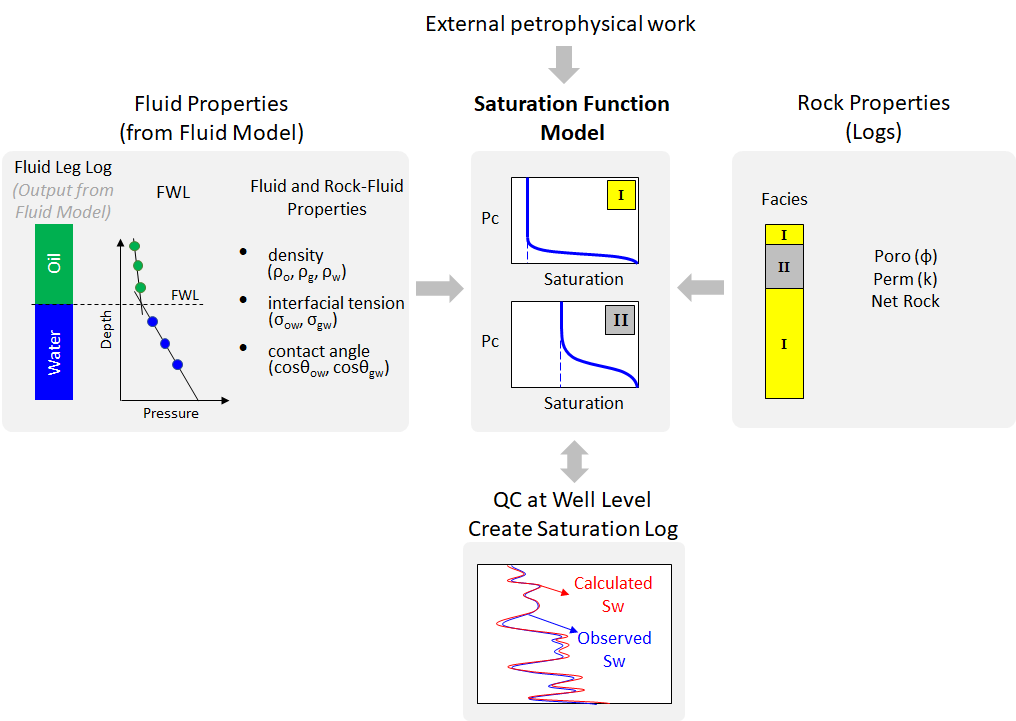
The Saturation Function Modeling workflow. click to enlarge
The result of the workflow is a Saturation Function Model which is a container holding all the associated metadata such as:
- Rock Properties The log sets of the rock properties (i.e. facies, porosity, permeability, net rock) which are used to define the saturation functions.
- Fluid Properties The properties which are obtained from the assigned fluid model:
- Free water level (FWL), and paleo FWL, if applicable.
- Fluid properties and rock-fluid properties (i.e. density, interfacial tension, contact angle).
- Fluid leg logs (i.e. output of the fluid model)
- Saturation Functions The saturation functions defined per (facies) class.
Saturation modeling requires QC processes at two different levels:
- QC at Well Level Once you complete the Saturation Function Modeling workflow, you can QC your model at well level. You can create saturation logs and compare the modeled Sw (i.e. based on your saturation function model) against the observed Sw (i.e. from well log interpretation or from core analysis). This is to ensure that everything has proceeded as intended and that you are able to reproduce the saturation match obtained in the external petrophysical work.
- QC at 3D Grid Level The second QC step is performed once you complete the Saturation Property Modeling workflow.
The Saturation Function Modeling workflow consists of the following steps: